
Understanding the Differential Current Principle in RCCBs
The Residual Current Circuit Breaker (RCCB) is the primary line of defense in Pakistani domestic and industrial installations against electric shock. Operating on the principle of Kirchhoff's Current Law, the RCCB monitors the balance between the phase (Live) and Neutral conductors. In a healthy single-phase circuit, the current flowing into the load via the phase wire must equal the current returning through the neutral wire. Any discrepancy indicates that a portion of the current is returning to the source via an unintended path, typically the Earth (PE) conductor or a human body.
At the heart of the RCCB is a highly sensitive Toroidal Current Transformer (CT). Both the phase and neutral wires pass through this magnetic core. Under normal conditions, the opposing magnetic fields generated by the equal currents cancel each other out, resulting in zero net flux in the core. When a leakage occurs—for instance, 30mA leaking through a damp 7/29 PVC cable—the imbalance induces a small voltage in the secondary sensing coil, which activates the trip mechanism. In the context of WAPDA's 220V 50Hz supply, even a high-resistance path of 7,333 Ohms to Earth is sufficient to trigger a 30mA RCCB ($I = V/R$; $220/7333 \approx 0.03A$).
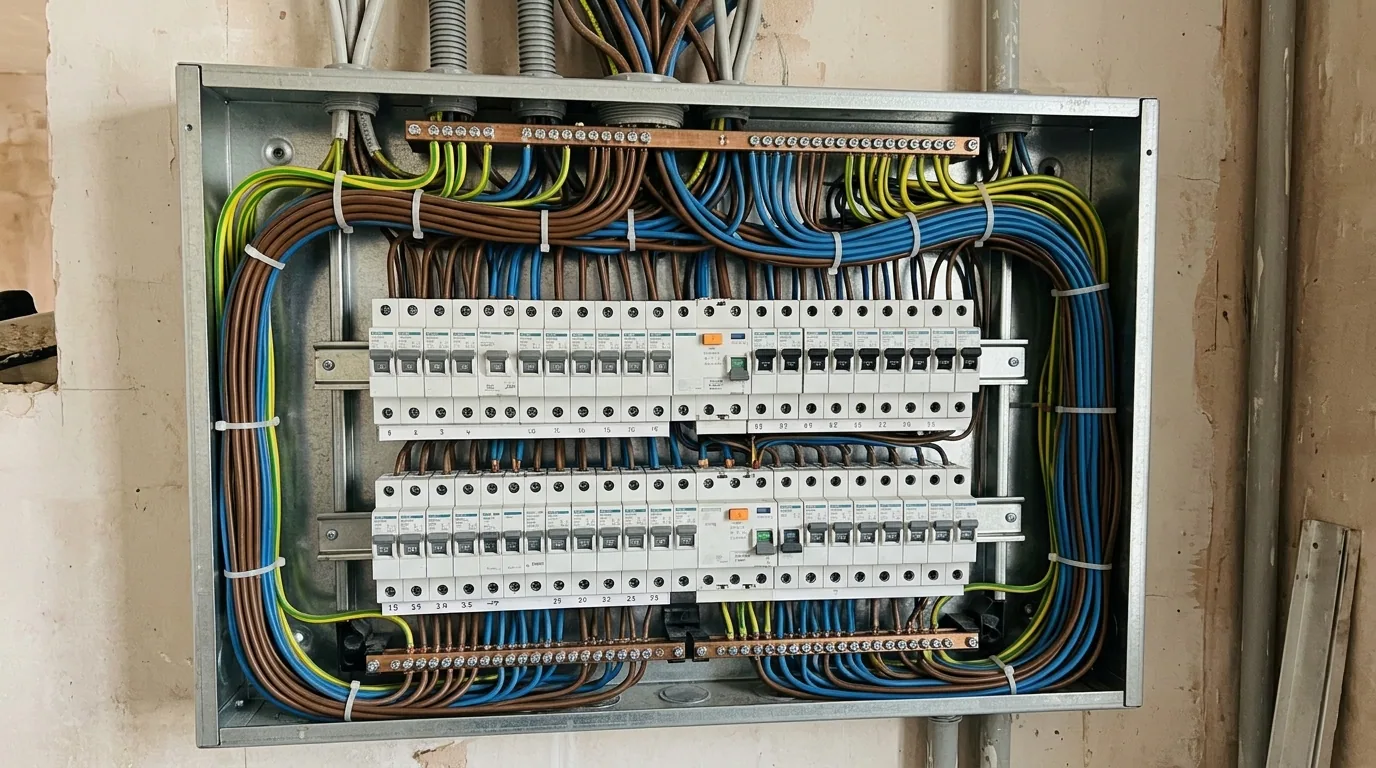
Click to expand
The Neutral-to-Earth Fault: The Hidden Culprit
One of the most frustrating scenarios for an electrician is when an RCCB trips even when all single-pole MCBs are in the 'OFF' position. This is a classic symptom of a Neutral-to-Earth fault. While the MCB breaks the phase connection, the Neutral wires usually remain connected to a common Neutral Busbar within the Distribution Board (DB). If a neutral wire has an insulation breakdown and touches the metallic conduit or an Earth wire, a portion of the return current from *other* active circuits can flow back through the Earth path instead of the designated neutral path through the RCCB.
Differential Diagnosis: Nuisance Tripping vs. Actual Fault
We must distinguish between 'Nuisance Tripping' (caused by transients, harmonics, or excessive cable lengths) and 'Actual Faults' (physical insulation failure). In Pakistan's harsh climate, where temperatures in Punjab can exceed 45C, PVC insulation on low-quality cables (non-standard 3/29 or 7/29) can become brittle, leading to micro-cracks that allow moisture ingress during the monsoon season.
Field Protocol
Diagnostic Step 1
Neutral Isolation Test
Isolate the entire DB by turning off the main DP (Double Pole) switch. Use a 500V DC Insulation Resistance Tester (Megger) to check the resistance between the Neutral Link and the Earth Bar. A reading below 2 Mega-Ohms ($\Omega$) indicates a neutral fault that will inevitably cause RCCB tripping once loads are applied elsewhere in the house.
Step-by-Step Isolation Procedure for Nuisance Tripping
When an RCCB refuses to stay engaged, follow this systematic professional workflow used by Apka Rafique technicians:
Standard Procedure
Diagnostic Step 2
Load Elimination
Disconnect all appliances from sockets. Physical removal of plugs is necessary as internal filters in appliances like refrigerators and washing machines can contribute to earth leakage even when switched off. If the RCCB still trips, the fault lies within the fixed wiring.
Advanced Diagnostics
Diagnostic Step 3
Sequential Branch Testing
Switch off all MCBs. Reset the RCCB. If it stays up, switch on MCBs one by one. The circuit that causes the trip is the culprit. If the RCCB trips with all MCBs OFF, you have a Neutral-to-Earth fault. You must then disconnect each neutral wire from the DB's neutral busbar one by one until the RCCB stays engaged.
Common Culprits in Pakistani Electrical Systems
Our field audits across Karachi, Lahore, and Islamabad have identified three primary repeat offenders for RCCB instability:

Click to expand
1. Moisture in Outdoor Junction Boxes: Decorative outdoor lighting or gate lights often use 'Gola' boxes that are not IP65 rated. Rainwater or high humidity creates a conductive bridge between the neutral terminal and the metallic casing. Always use resin-filled joints or weather-proof enclosures for external 7/29 or 7/44 wiring.
2. Submerged Water Pump Cables: The flexible 7/36 or 7/44 cables feeding submersible pumps often deteriorate over time. Since these are in direct contact with water, even a pinhole leak in the insulation results in immediate current leakage to Earth, exceeding the 30mA threshold.
3. Improper Neutral-Earth Bonding: In some older Pakistani constructions, 'protective multiple earthing' is misunderstood. If the Neutral and Earth are bonded together *after* the RCCB, the device will trip immediately upon the application of any load, as the return current divides between the Neutral and Earth paths.
Technical Specifications & Thresholds
The following table outlines the standard parameters for RCCB selection and diagnostic limits in Pakistani residential units.
RCCB Technical Matrix
Standard Ratings
In summary, RCCB nuisance tripping is rarely 'random.' It is the mathematical result of leakage currents exceeding the calibrated magnetic flux of the toroidal core. By systematically isolating neutral conductors and utilizing insulation resistance testing, electricians can move beyond guesswork and ensure a stable, safe electrical environment.
Topics & Tags:#RCCB Tripping#Earth Leakage#Neutral Fault#House Wiring Pakistan#Electrical Diagnostics
Further Technical Reading
View allRelated Articles & Guides

House Wiring
6 min read
Home Distribution Board Safety: 30mA RCCB Shock Protection and Earthing Resistance Standards
Read Guide
Fans & Motors
9 min read
Capacitor Sizing for Ceiling Fans: Microfarad Rating vs Winding Heat Rise
Read Guide
Wiring
8 min read
Identify Pure Copper vs CCA Wire Using Flame: A Master Electrician's Guide
Read Guide