
The Economic Reality of CCA Wire in Pakistan's Electrical Market
In the local markets of Lahore, Karachi, and Rawalpindi, electrical wire is often sold under two distinct categories: '99.9% Pure Copper' and 'Bazar Quality.' The latter is almost always Copper-Clad Aluminum (CCA), a deceptive product consisting of an aluminum core with a thin electroplated coating of copper. While CCA has its place in high-frequency signal applications like networking, it is a catastrophic fire hazard when used for WAPDA 220V/400V power distribution, especially under the grueling 45°C Pakistani summer heat where ambient temperatures already push insulation to its limits.
Diagnostic Procedure
Diagnostic Step
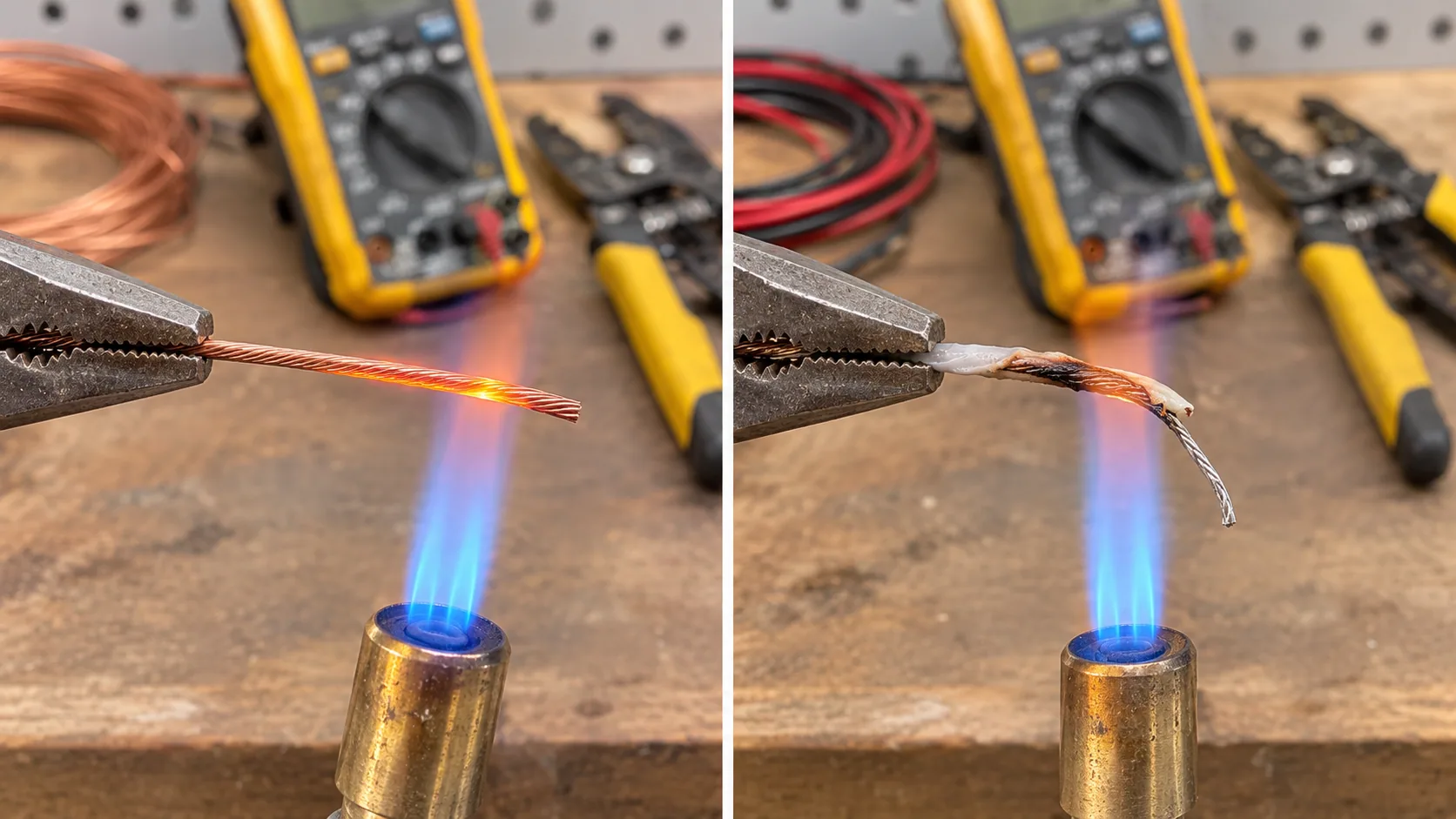
The Professional Flame Test
1. Strip approximately 2 inches of insulation from the wire sample. 2. Use a butane torch or a high-intensity lighter to heat the exposed strands for 10-15 seconds. 3. Observe the physical state of the metal during and after heating. 4. Attempt to bend the wire once it has cooled slightly.
Interpreting Flame Test Results: Copper vs. CCA
When subjected to a flame, pure copper will glow cherry red. It will maintain its structural integrity and, once the flame is removed, will appear charred or black due to the formation of copper oxide, but it will remain flexible and strong. In contrast, CCA wire fails the test immediately. Because aluminum has a significantly lower melting point (660°C) compared to copper (1,085°C), the inner aluminum core will liquefy while the outer copper skin holds it briefly. The wire will typically droop, turn a brittle white or grey, and will snap easily between your fingers after cooling.
Click to expand
Weight and Resistance: The Mathematical Verification
Beyond the flame test, professional electricians in Pakistan use two definitive metrics: weight and electrical resistance. Copper is approximately 3.3 times denser than aluminum. A standard 90-meter (approx. 100-yard) coil of 7/29 pure copper wire is significantly heavier than its CCA counterpart. For domestic installations, identifying the gauge (like 3/29 for lighting or 7/29 for sockets) is only half the battle; verifying the metal density is the final check.
Wire Weight Benchmarks
Standard 90-Meter Coil Comparison (Approximate)
Measuring Resistance with a Multimeter
Using a digital multimeter set to the lowest Ohm (Ω) range, you can calculate the quality of the conductor. According to the formula R = ρ (L/A), where ρ (rho) is the resistivity, copper's value is 1.72 x 10^-8 Ω·m, while aluminum is 2.65 x 10^-8 Ω·m. If you measure a 10-meter length of 7/29 wire and find the resistance is significantly higher than 0.2 ohms, you are likely dealing with CCA or 'adulterated' copper with high impurity content. High resistance leads to I²R losses, causing the wire to heat up inside PVC conduits, leading to insulation failure and short circuits.
Long-Term Hazards of CCA in Pakistani Homes
Installing CCA wire in a concealed wiring system in Pakistan is a recipe for disaster for three primary reasons: Thermal Expansion, Galvanic Corrosion, and Voltage Drop. Aluminum expands and contracts at a different rate than the brass terminals found in Schneider breakers or local piano switches. This leads to 'creep,' where the connection becomes loose over time, causing arcing and fires. Furthermore, when moisture enters the system, the contact between the copper coating and aluminum core creates a galvanic cell, corroding the wire from the inside out.
Comparison Matrix: Copper vs. CCA for Domestic Use
To summarize the differences for both homeowners and professional contractors, the following matrix outlines why 'cheap' wire is an expensive mistake.
{"type":"comparison","title":"Material Comparison Table"}
Final Verdict: How to Protect Your Investment
When purchasing wire for a new project or renovation, always insist on brands that comply with Pakistan Standards and Quality Control Authority (PSQCA). Brands like Pakistan Cables and Fast Cables are industry standards for a reason. Always perform the 'Scrape Test' (using a knife to see if the silver aluminum shows through the copper) and the 'Flame Test' on a sample from the actual coil you are buying. Saving 30% on wire costs today can lead to a 100% loss of your property due to electrical fires tomorrow.
Topics & Tags:#Pure Copper Test#CCA Wire Hazards#Pakistan Electrical Standards#Wiring Safety#Flame Test Guide
Further Technical Reading
View allRelated Articles & Guides
Wiring
9 min read
3/29 vs 7/29 vs 7/36 Wire Gauge Guide: Professional Standards for Pakistan
Read Guide
Wiring
5 min read
AC Wiring Conduit Thermodynamics: Why 2.5mm² Cables Melt in 45°C Heat and Why 4.0mm² Is Mandatory
Read Guide
Fans & Motors
9 min read
Capacitor Sizing for Ceiling Fans: Microfarad Rating vs Winding Heat Rise
Read Guide