
The Engineering Reality of Ceiling Fan Speed Degradation
In Pakistan, the most common 'quick fix' for a slow-moving ceiling fan is replacing the capacitor. However, understanding ceiling fan capacitor size requires more than just swapping a 2.5µF for a 3.5µF unit. Most ceiling fans used in local households (GFC, Royal, Pak Fan) utilize a Permanent Split Capacitor (PSC) motor. This motor relies on the capacitor to create a phase shift between the main winding and the auxiliary (start) winding. When the capacitance drops, the magnetic field becomes elliptical rather than circular, resulting in reduced starting torque and lower RPM.
Why Capacitor Electrolytes Degrade in Pakistan
The capacitors used in ceiling fans are typically CBB61 metallized polypropylene film capacitors. These components face significant thermal stress. With ambient temperatures exceeding 45°C in cities like Multan or Jacobabad, the internal dielectric material undergoes accelerated aging. This leads to a loss of capacitance (measured in microfarads or µF). Furthermore, winding resistance shifts slightly due to oxidation and thermal cycling, which alters the L-C resonance of the motor circuit, further slowing the fan speed over time.
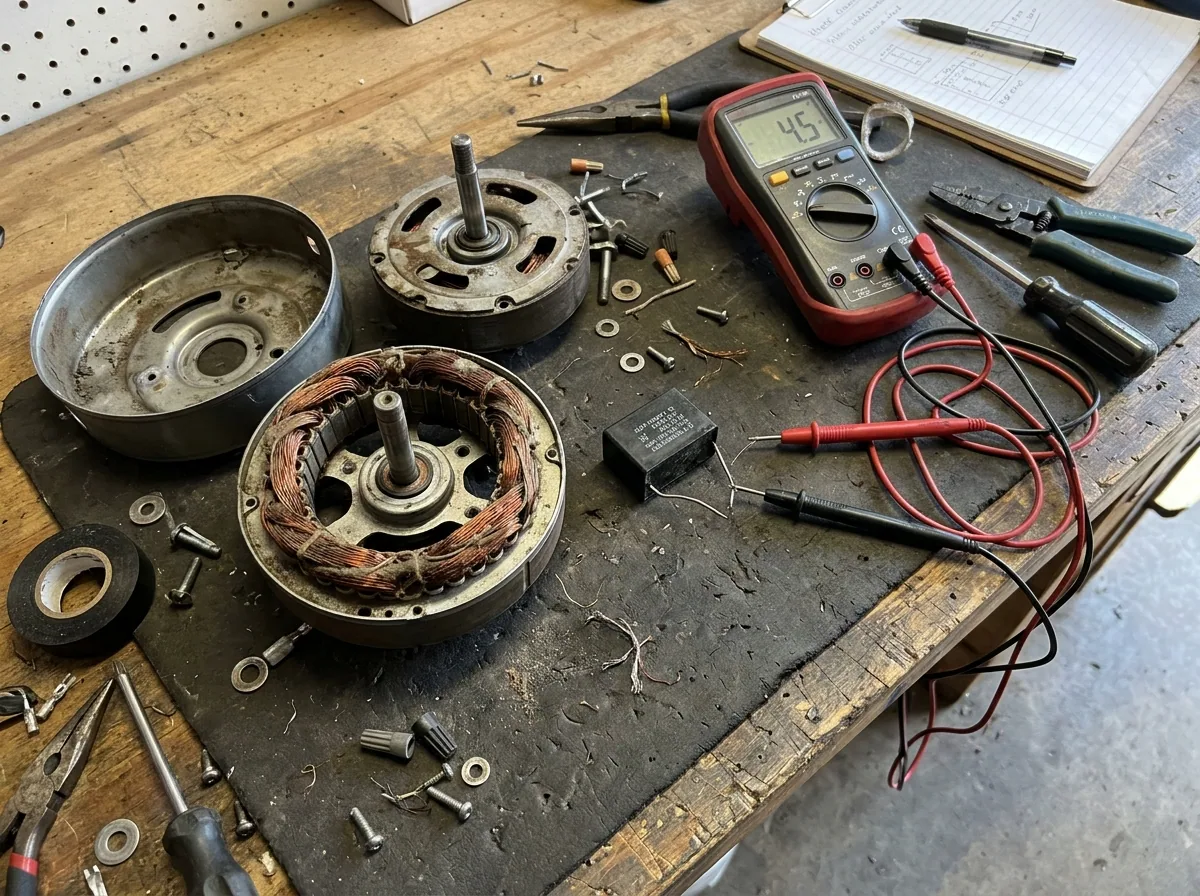
Click to expand
The Danger of Over-Sizing: Why 3.5uF Cooks the Motor
A common mistake by local electricians is installing a 3.5µF or even a 4.5µF capacitor on a 56-inch fan originally designed for a 2.25µF rating. While the RPM increases significantly, the physics of motor heat dictates a dangerous trade-off. The current (I) in the auxiliary winding is inversely proportional to the capacitive reactance (Xc). The formula for capacitive reactance is Xc = 1 / (2πfC).
Technical Note
Heat Rise Calculation
The I2R Effect
By increasing the capacitance from 2.25µF to 3.5µF, you decrease Xc by approximately 35%. This results in a roughly 35% increase in current through the start winding. Since heat is proportional to the square of the current (P = I²R), a 35% current increase leads to nearly an 80% increase in heat generation within the stator windings.
In a 45°C ambient environment, the fan motor is already operating near its insulation temperature limit (typically Class E or Class B insulation). The additional 80% heat rise caused by an oversized capacitor causes the varnish on the copper windings to brittle and crack. This eventually leads to an internal short-circuit and motor burnout.
Standard Replacement Guide for Pakistani Ceiling Fans
Capacitor Selection Matrix
Standard ratings for 220V/50Hz supply
{"type":"comparison","title":"Capacitor Quality Comparison"}
Diagnostic Workflow for Slow Fans
Before assuming the capacitor is faulty, perform these diagnostic steps in order. This prevents unnecessary heat stress on a healthy motor.
Workshop Standard
Step 1: Mechanical Friction Check
Bearings & Alignment
Turn the fan off and spin the blades by hand. If there is resistance or a grinding noise, the 6202 or 6203 bearings are failing. Increasing the capacitor size to overcome mechanical friction will burn out the motor within days.
WAPDA Check
Step 2: Voltage Measurement
Input Verification
Use a multimeter to check the voltage at the fan terminals. If it is below 200V, the slow speed is a supply issue. Do not increase the microfarad rating to compensate for low voltage.
Pro Tip
Step 3: Capacitance Testing
Multimeter Check
Disconnect the capacitor and measure it with a meter. If a 2.25µF unit reads below 1.8µF, it must be replaced. Only replace with the exact original value.
Conclusion: Protecting the Fan Stator
While a higher ceiling fan capacitor size provides an immediate speed boost, it is a detrimental long-term strategy for Pakistani electrical systems. The excessive motor heat generated during summer months will inevitably lead to winding failure. For optimal performance, always select a 400V-450V AC rated metallized polypropylene capacitor matching the manufacturer's original specification, and ensure your wiring uses high-quality 3/29 or flexible cables to minimize voltage drop.
Topics & Tags:#Ceiling Fan Repair#Capacitor Rating#Motor Winding#Electrical Maintenance#WAPDA Standards
Further Technical Reading
View allRelated Articles & Guides

Fans & Motors
4 min read
Ceiling Fan Speed Loss Diagnosis: Capacitor Capacitance Degradation vs Stator Bearing Drag
Read Guide
Wiring
8 min read
Identify Pure Copper vs CCA Wire Using Flame: A Master Electrician's Guide
Read Guide
Solar & Battery
12 min read
1000V DC Solar Disconnect Breakers vs AC MCBs: Arc Quenching Explained
Read Guide