
In residential construction across Mianwali, homeowners invest millions of rupees in imported floor tiles, luxury paint, and expensive light fixtures, while allowing contractors to cut corners on the most vital life-safety system in the building: the Main Distribution Board (DB). In dozens of homes inspected annually, Earth Leakage Circuit Breakers (RCCB / ELCB) are completely omitted, earthing rods are non-existent or disconnected, and circuits are protected by cheap counterfeit circuit breakers. This craftsman guide outlines the life-saving physics of 30mA residual current protection, earthing standards under 5 Ohms, and neutral loop isolation.

Click to expand
The Physiology of Electric Shock: Why MCBs Do NOT Protect Human Life
The most prevalent misconception among homeowners is that a standard Miniature Circuit Breaker (MCB) protects human beings from electrocution. A standard domestic MCB is rated for 16 Amperes, 20 Amperes, or 32 Amperes. It is designed solely to protect copper wires from melting during thermal overloads and short circuits.
How a 30mA Residual Current Device (RCCB / ELCB) Saves Lives
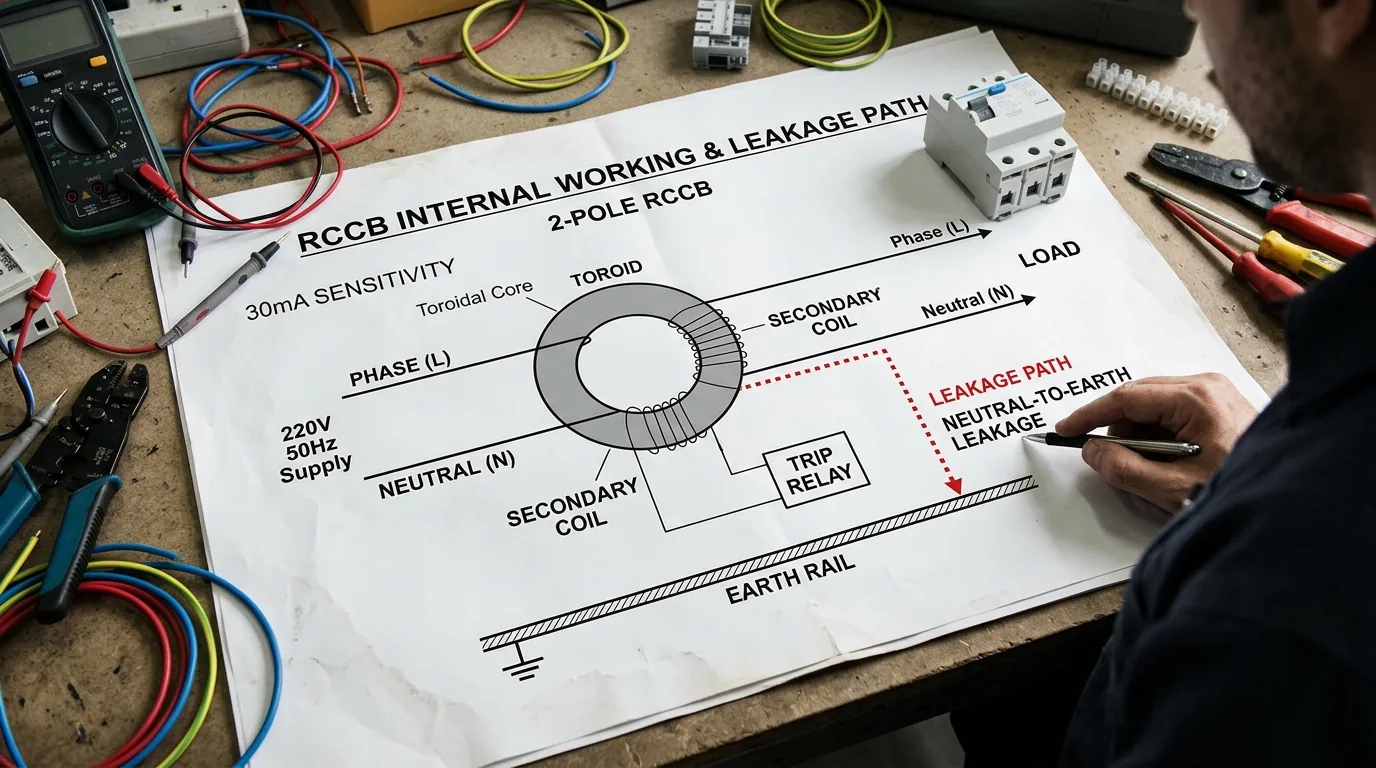
A Residual Current Circuit Breaker (RCCB) operates using a core balance current transformer that simultaneously measures the current entering through the phase wire and returning through the neutral wire. Under normal conditions, Phase Current equals Neutral Current (I_phase - I_neutral = 0).
Distribution Board Protection Component Matrix
Mandatory international standards under IEC 60364-4-41 and BS 7671
| Protective Device | Primary Protection Target | Trip Speed / Threshold | Prevents Fatal Electrocution? |
|---|---|---|---|
| Miniature Circuit Breaker (MCB) | Copper cable overheating & direct short-circuits | 10A - 32A sustained load | NO (Allows 10A+ through body) |
| 30mA RCCB / ELCB (Residual Current) | Human life against ground shock & wet room leaks | 30mA leakage in < 40 milliseconds | YES (Certified life protection) |
| 100mA / 300mA RCCB | Building fire protection against wall arc leaks | 100mA - 300mA leakage | NO (Threshold too high for human heart) |
| Surge Protection Device (SPD Type 2) | Inverter electronics & appliances against lightning | 20kA - 40kA surge clamp in nanoseconds | Protects equipment insulation |
The Earthing Standard: Why Sandy Soil Demands Copper Rods Under 5 Ohms
Earthing provides a low-impedance path to ground so fault current can safely clear without charging the metal chassis of washing machines, refrigerators, and water pumps. In the dry, sandy soils common to Mianwali, driving a short 4-foot iron rebar rod into dry soil results in an earthing resistance of 80 to 150 Ohms. Under an active fault, this high resistance fails to clear the fault, electrifying every metal appliance in your home.
The Apka Rafique 4-Point Distribution Board Checklist
1. 30mA RCCB on Main DB
Mandatory Life Protection
Install a certified European-standard 30mA RCCB immediately following the main double-pole isolator to protect all branching domestic sub-circuits.
2. Tested Earth Rod (< 5 Ohms)
Digital Earth Tester Proof
Verify soil resistance with a 3-point fall-of-potential digital earth tester. Never rely on water pipes or foundation rebar as an earth ground.
3. Independent Inverter Neutral
Prevent Nuisance Trips
Separate solar and UPS neutrals completely from the grid neutral busbar to prevent RCCB nuisance tripping and circulating earth leakage.
4. Continuous Un-spliced Earth Line
Green / Yellow Copper Lead
Run continuous 4.0mm² or 6.0mm² green/yellow earth conductors to all power points, electric geysers, and motor pump housings.
Topics & Tags:#distribution board#rccb#elcb#earthing rod#shock protection#earth leakage#mcb curve#house wiring#mianwali
Further Technical Reading
View allRelated Articles & Guides
House Wiring
9 min read
RCCB Nuisance Tripping Diagnostics: Neutral-to-Earth Leakage vs Actual Fault
Read Guide

Motor Rewinding
6 min read
Motor Rewinding Metallurgy: Why 99.9% Electrolytic Copper Outlasts CCA in Extreme 45°C Heat
Read Guide
Wiring
5 min read
AC Wiring Conduit Thermodynamics: Why 2.5mm² Cables Melt in 45°C Heat and Why 4.0mm² Is Mandatory
Read Guide