
When a ceiling fan crawls on speed five during the peak of summer, homeowners and inexperienced electricians make an immediate mistake: they replace the factory 2.5µF or 3.15µF capacitor with an oversized 4.0µF or 5.0µF capacitor to 'force it to spin faster.' While the fan may briefly accelerate, this excessive capacitance injects heavy auxiliary winding current, driving internal copper temperatures past 140°C and burning the stator within weeks. This technical guide explains how to properly diagnose capacitor loss, mechanical bearing drag, and shorted coil turns.

Click to expand
The Physics of the Auxiliary Phase Shift (Why Capacitors Create Rotation)
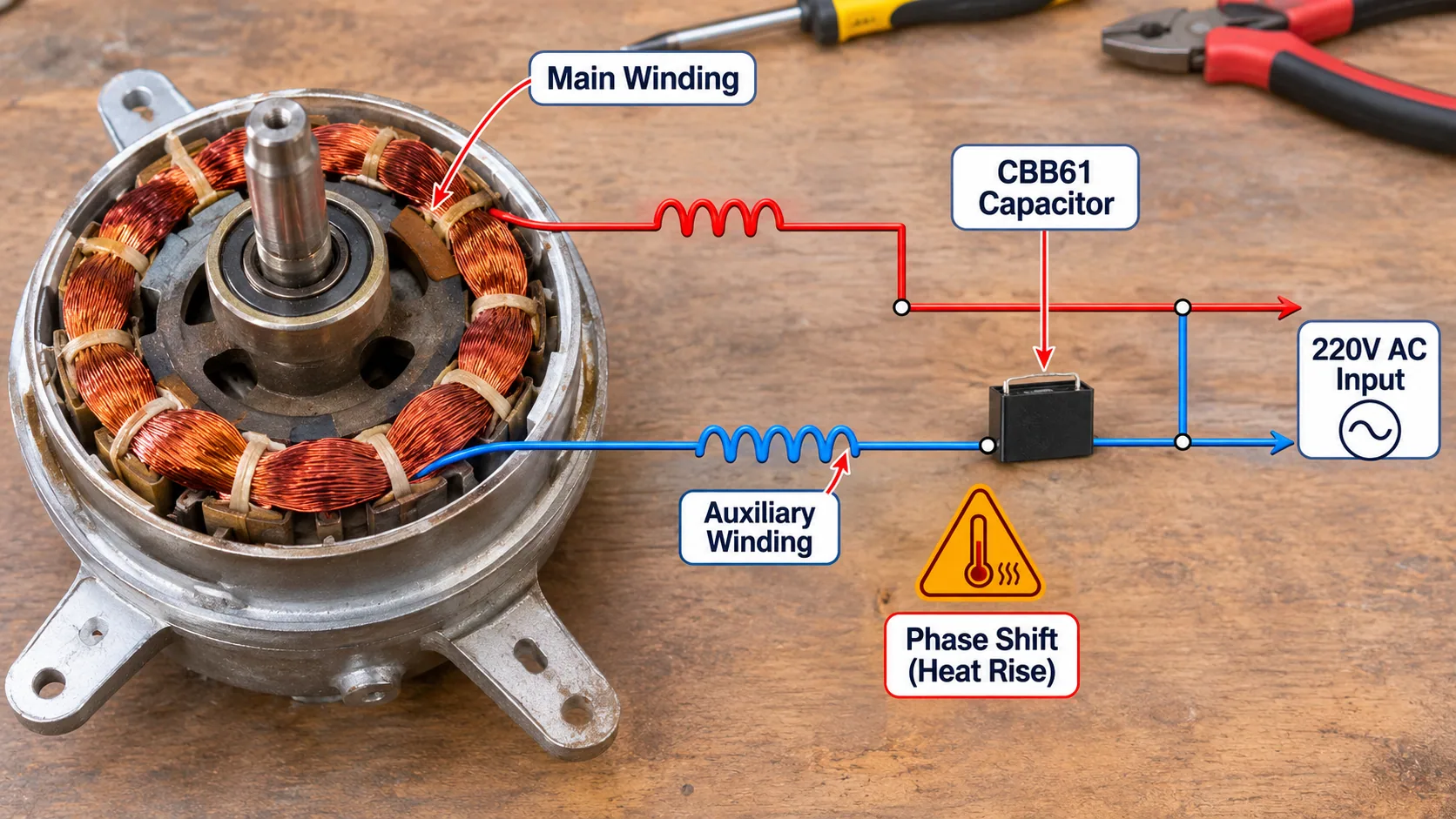
Single-phase alternating current cannot generate a rotating magnetic field on its own; it creates an alternating, pulsating field with zero net starting torque. To create rotation, ceiling fans use a permanent split capacitor (PSC) motor design with two windings placed at 90 electrical degrees: the Main (Running) Winding and the Auxiliary (Starting) Winding.
Capacitance Degradation Thresholds
Metallized polypropylene film capacitors degrade over time through self-healing cycles caused by voltage spikes and ambient heat. As microscopic dielectric micro-shorts occur, internal zinc-aluminium metal film evaporates, steadily reducing total microfarad (µF) rating.
Capacitor Degradation and Fan Torque Impact Table
Verified test bench measurements on 56-inch domestic ceiling fan stators
| Nominal Rating | Measured Microfarads | Starting Torque Loss | Speed Deficit (RPM) | Diagnosis & Action |
|---|---|---|---|---|
| 3.15 µF | 3.00 to 3.25 µF | 0% (Optimal) | Full 330 - 340 RPM | Healthy capacitor |
| 3.15 µF | 2.40 to 2.70 µF | 20% - 25% Drop | Drops to 260 - 280 RPM | Early degradation; replace with 3.15µF |
| 3.15 µF | 1.50 to 2.00 µF | 45% - 55% Drop | Crawls at 180 - 200 RPM | Severe failure; fan hums and stalls |
| 3.15 µF | 4.00 µF (Oversized) | Torque spikes, +60% I²R Heat | 350 RPM (Overheats) | Dangerous! Auxiliary winding will burn out |
The 30-Second Physical Diagnostic: Bearing Drag vs Shorted Winding
Before replacing components, perform these three physical checks with the power switched off:
Mechanical
1. The Free Spin Test
Bearing Drag Check
Gently push the fan blade by hand with power off. A healthy fan with good 6201/6202 bearings will spin silently for 20 to 35 seconds before stopping smoothly. If it stops within 5 seconds with a dry scraping noise, the ball bearings have hardened grease and need replacement.
Electrical
2. The 10-Minute Heat Test
Shorted Turn Check
Run the fan for 10 minutes, then touch the top metal motor housing. If the housing is blisteringly hot to the touch while spinning slowly, coil enamel has melted and turns are short-circuited. Changing the capacitor will not fix this; rewinding is mandatory.
Vibration
3. The Shaft Play Test
Alignment Check
Grasp the motor body and gently push vertically and laterally. Any radial or axial play indicates worn bearing seating sleeves or a loose suspension bolt.
Interactive Tool: Fan Capacitor Degradation & Torque Deficit Estimator
Enter your fan's nominal capacitor value and measured capacitance or observed speed drop to evaluate the exact torque deficit and recommended repair path.
Interactive Workshop Tool
Ceiling Fan Capacitor & Torque Health Estimator
PSC Motor Phase Shift & Microfarad Diagnostic
Assess auxiliary winding torque loss, heat penalty, and proper replacement rating.
Input ParametersLive calculation
µF
µF
2.1 µF
Measured using a digital multimeter with microfarad capacitance mode
Calculated Diagnostics
Capacitance Variance-33% Low
Starting Torque Impact-43% Deficit
Auxiliary Coil Heat SurchargeNormal
Bearing ConditionSmooth (Pass)
Your capacitor has lost 33% of its capacitance, causing a 43% torque deficit.
Replace capacitor strictly with a certified 3.15µF unit. Never install 4.0µF or 5.0µF.
Topics & Tags:#ceiling fan#fan capacitor#bearing drag#6201 bearing#6202 bearing#coil rewinding#phase shift#mianwali#auxiliary winding
Further Technical Reading
View allRelated Articles & Guides
Fans & Motors
9 min read
Capacitor Sizing for Ceiling Fans: Microfarad Rating vs Winding Heat Rise
Read Guide

Motor Rewinding
6 min read
Motor Rewinding Metallurgy: Why 99.9% Electrolytic Copper Outlasts CCA in Extreme 45°C Heat
Read Guide
Wiring
5 min read
AC Wiring Conduit Thermodynamics: Why 2.5mm² Cables Melt in 45°C Heat and Why 4.0mm² Is Mandatory
Read Guide