
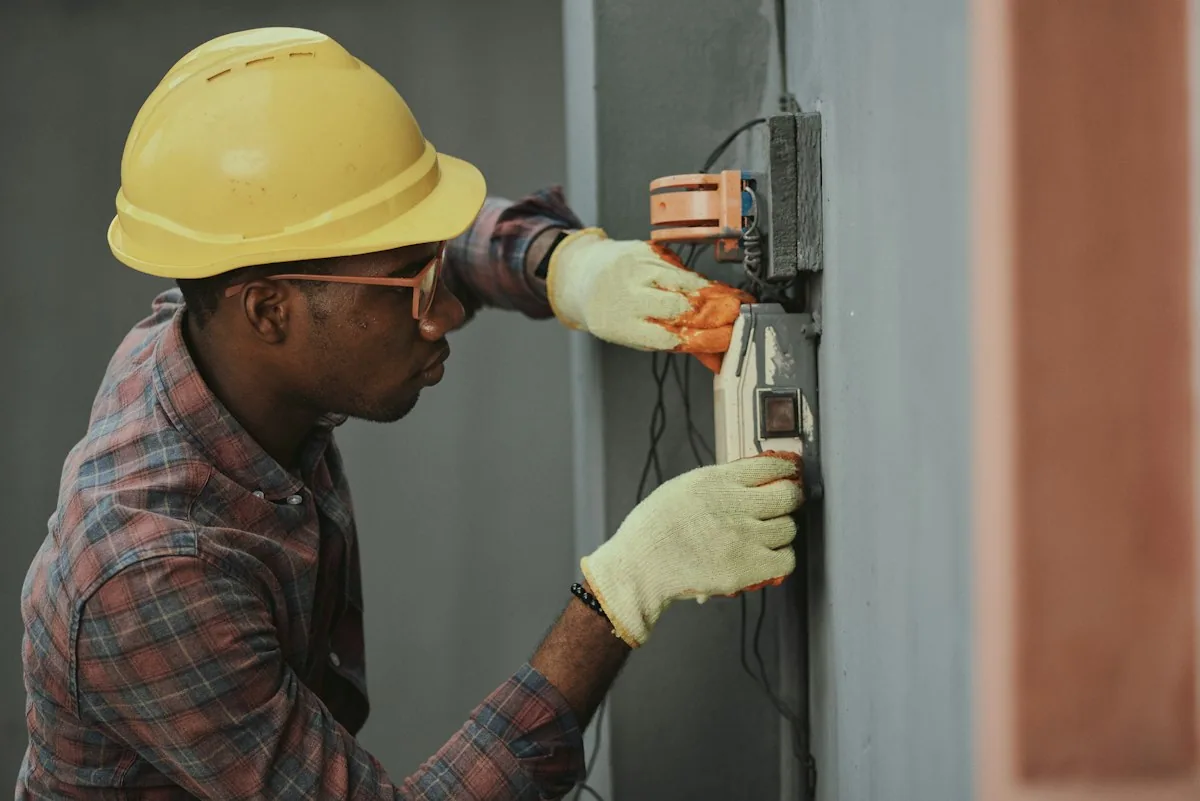
In the electrical trade across Punjab, contractors routinely make a dangerous assumption: they glance at the nameplate of a 1.5 Ton (18,000 BTU) inverter air conditioner, note a rated running current of 6.5A to 8.0A, and specify 2.5mm² (7/29 equivalent) wiring. On paper and under standard lab test conditions (25°C ambient, nominal 230V grid), that calculation seems acceptable. Inside a sealed PVC conduit embedded in masonry under a 45°C to 48°C Mianwali summer sun, that calculation becomes an active fire hazard.
Click to expand
The Ambient Derating Physics: Why Free-Air Ratings Fail Inside PVC Walls
Standard cable manufacturer specification sheets frequently cite cable ampacity in open, free air at an idealized baseline of 30°C. Under these theoretical conditions, standard single-core 2.5mm² PVC cable is rated for approximately 24A. However, electrical installations must strictly adhere to international engineering standards (BS 7671 and IEC 60364-5-52, Installation Method B1 / B2 for cables enclosed in conduit within thermally insulated or masonry walls).
When enclosed in conduit inside masonry, the baseline current rating of 2.5mm² drops immediately from 24A down to 18.5A. Applying the 45°C temperature derating factor (0.79) yields a maximum continuous ampacity of only 14.6A. Factor in the mandatory 80% continuous load safety margin (loads sustained over 3 hours), and a 2.5mm² cable must never be loaded beyond 11.6A. When WAPDA grid voltage drops from 220V down to 170V during peak afternoon hours, an inverter compressor draws 11.2A to 11.8A to deliver full cooling tonnage—operating the cable right at its thermal ceiling.
Engineering Comparison: 2.5mm² vs 4.0mm² Pure Copper Inside Conduit at 45°C
Standards under BS 7671 Method B2 & IEC 60364-5-52
| Engineering Metric | 2.5mm² Copper (7/29 Class) | 4.0mm² Copper (7/36 Class) |
|---|---|---|
| Conductor DC Resistance (at 20°C) | 7.41 mΩ/m | 4.61 mΩ/m (-37.8%) |
| Conductor DC Resistance (at 70°C) | 8.87 mΩ/m | 5.52 mΩ/m |
| Base Rating in Conduit (30°C) | 18.5 A | 25.0 A |
| Derated Ampacity (45°C Ambient, Ca=0.79) | 14.6 A | 19.75 A |
| Max Safe Continuous Load (80% Rule) | 11.68 A | 15.8 A |
| Heat Generated at 11A Load (per 20m run) | 42.9 Watts | 26.7 Watts (38% Drop) |
| Recommended MCB Protection | 16A Type C | 20A Type C |
Plasticizer Migration and Insulation Embrittlement Above 70°C
Polyvinyl chloride (PVC) is inherently rigid. To make it pliable enough for electrical cable insulation, chemical plasticizers (typically phthalate esters) are blended into the compound. When conductor core temperatures continuously exceed 70°C inside unventilated conduits, a destructive 4-phase chemical breakdown occurs:
Thermal Stress
Phase 1: Volatilization & Leaching
Loss of Flexibility
Liquid plasticizer molecules diffuse outward toward the insulation surface and evaporate inside sealed conduit, leaving a stiff, brittle polymer matrix.
Mechanical Stress
Phase 2: Radial Shrinkage
Conduit Pinching
As plasticizers escape, the insulation wall thins and shrinks radially, creating severe mechanical tension across 90-degree conduit elbows and junction boxes.
Insulation Failure
Phase 3: Micro-Cracking
Dielectric Collapse
The brittle PVC develops microscopic fissures under thermal expansion cycles. Dielectric resistance drops from hundreds of megaohms down to low kiloohms.
Catastrophic
Phase 4: Arc Tracking & Pipe Fusion
Active Fire Hazard
Micro-arcing occurs between the phase conductor and neutral or conduit wall. The accumulated thermal energy melts the adjacent PVC conduit, bonding copper directly to wall masonry.
Type C vs Type B Circuit Breakers: Why Compressors Trip Standard Breakers
Many homeowners complain that their newly installed air conditioner frequently trips the main distribution board breaker upon startup, leading negligent technicians to swap the breaker for an oversized 32A or 40A unit. This practice bypasses thermal overload protection and turns in-wall wiring into an open fuse.
Interactive Tool: AC Cable Sizing & Thermal Derating Simulator
Calculate your exact continuous compressor amperage under local grid voltage drops and see the derated ampacity safety margin across 2.5mm² versus 4.0mm² conductors inside wall conduits.
Interactive Workshop Tool
Inverter AC Cable Derating & Sizing Calculator
Conduit Ampacity & Voltage Sag Safety Simulator
Verify compressor running current and conductor thermal headroom under extreme summer ambient temperatures.
Input ParametersLive calculation
Volts
°C
45 °C
Interior wall: ~35°C | Sun-baked exterior wall: ~45°C | Unventilated false ceiling: ~50°C
Calculated Diagnostics
Compressor Continuous Current10.50 Amperes
2.5mm² Safe In-Conduit Limit11.7 Amperes
4.0mm² Safe In-Conduit Limit15.8 Amperes
2.5mm² Thermal Headroom+1.2A Margin
At 180V supply and 45°C ambient, your 1.5 Ton AC draws 10.5A. A 2.5mm² cable has narrow headroom.
Ensure cable runs are un-spliced and protected with a Type C MCB.
The Apka Rafique AC Installation Standard
1. Continuous Un-spliced Runs
Zero Wire Nuts in Conduits
Pull unbroken 4.0mm² single-core conductors directly from the main distribution board to the local DP isolator. Zero intermediate taped joints.
2. Certified 99.9% Pure Copper
No Local Sub-Gauges
Never allow Copper-Clad Aluminium (CCA) or local sub-gauge wire on high-draw inductive compressor circuits.
3. Dedicated Isolated Neutral
Prevent Neutral Overheating
Run a dedicated full-gauge 4.0mm² neutral directly to the DB neutral busbar. Never loop neutral lines across general room sockets.
4. Dedicated 20A Type C Breaker
Compressor Inrush Protection
Protect each 1.5 Ton AC run with a high-grade 20A Type C MCB rated for minimum 6kA interrupting capacity.
Topics & Tags:#ac wiring#conduit#derating factor#copper cable#type c mcb#heat loss#air conditioner#mianwali#plasticizer
Further Technical Reading
View allRelated Articles & Guides
Wiring
8 min read
Identify Pure Copper vs CCA Wire Using Flame: A Master Electrician's Guide
Read Guide
Wiring
9 min read
3/29 vs 7/29 vs 7/36 Wire Gauge Guide: Professional Standards for Pakistan
Read Guide

Motor Rewinding
6 min read
Motor Rewinding Metallurgy: Why 99.9% Electrolytic Copper Outlasts CCA in Extreme 45°C Heat
Read Guide